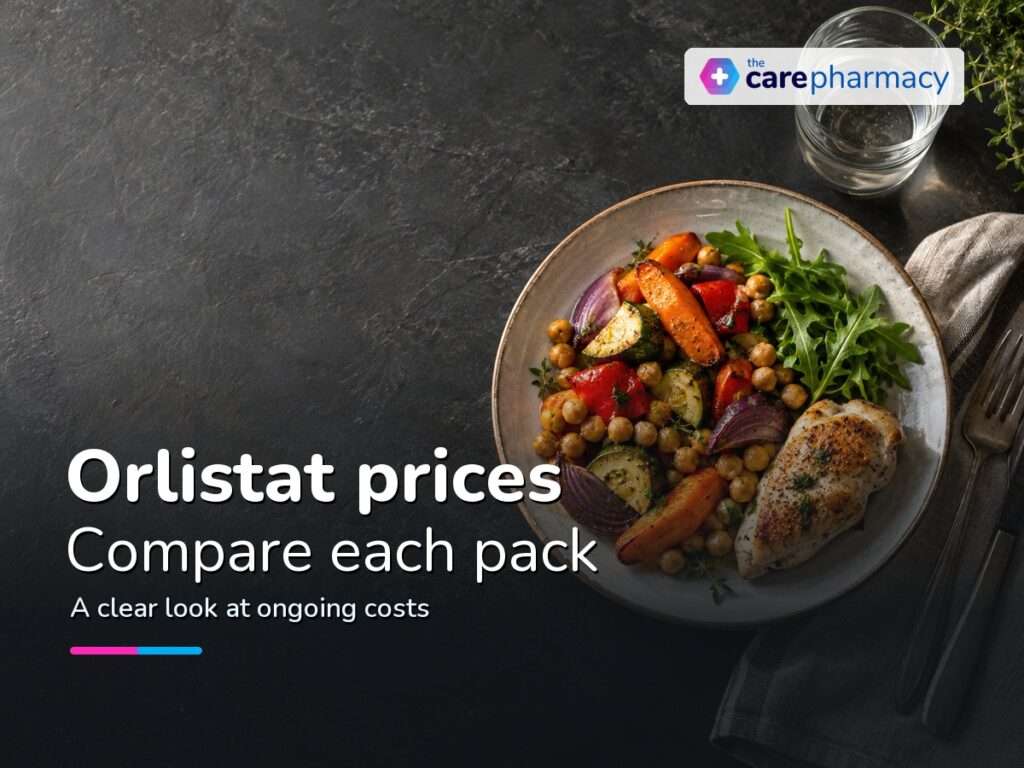
Orlistat Price Comparison UK: 120mg Capsule Costs
Compare orlistat prices for 84 generic 120mg capsules in the UK. Check pack costs, delivery and the full payable total.
June 2026 · The Care Pharmacy ·
Clinically reviewed by Mohammed Ismail Lakhi MPharm, Superintendent Pharmacist
The question coming up more and more: is there a pill version of Mounjaro or Wegovy? The short answer is – the Wegovy pill is available now in the UK.
The landscape has moved fast, and understanding what’s available (and what’s coming) keeps you ahead of the curve.
Thinking about your options? Get in touch with our prescribing team or complete our free online consultation to find out which weight management treatment is right for you.
GLP-1 stands for glucagon-like peptide-1. It is a hormone your body naturally produces in the gut after eating. When GLP-1 is released, it signals to the brain that you have eaten, slows the rate at which your stomach empties, and suppresses appetite. In people with obesity, these signals are often dysregulated – meaning the body does not respond to food intake in a way that curbs overeating effectively.
GLP-1 receptor agonists (GLP-1 RAs) are medicines that mimic and amplify this natural hormone. They were originally developed for type 2 diabetes, where they help regulate blood sugar. Researchers and clinicians quickly observed that patients also lost meaningful amounts of weight – not as a side effect, but as a direct result of the treatment’s mechanism of action. Higher doses, developed specifically for obesity rather than diabetes, followed. That is how treatments like Wegovy and Mounjaro came to be.
Mounjaro (tirzepatide) is technically a dual agonist – it targets both GLP-1 receptors and GIP (glucose-dependent insulinotropic polypeptide) receptors. This combination is thought to produce greater weight loss than GLP-1 action alone. Wegovy (semaglutide) is a GLP-1 agonist only, but still produces substantial, clinically meaningful weight reduction.
Wegovy is now available both as a once-weekly subcutaneous injection and as an oral tablet, and Mounjaro is delivered as a once-weekly subcutaneous injection – a short, fine needle injected into the skin of the abdomen, thigh, or upper arm. Injections have worked extremely well for most patients, but a proportion of the people who might benefit from these treatments either cannot tolerate injections, find the routine difficult to sustain, or simply prefer not to inject. That is why the arrival of an oral formulation has attracted significant interest from manufacturers, clinicians, and patients alike.
Before exploring the oral option, it is worth being clear about the injectables that remain the backbone of weight management treatment in the UK.
Mounjaro was approved by the MHRA for weight management in November 2023. NICE issued full guidance (TA1026) in December 2024 and NHS access via specialist weight management services began in March 2025. Treatment starts at 2.5mg once weekly and titrates every four weeks up to a maximum of 15mg.
The SURMOUNT-1 trial demonstrated average body weight reductions of up to approximately 20.9% at 72 weeks at the highest dose, in adults without type 2 diabetes. This remains the most clinically significant weight loss result of any approved pharmacotherapy to date. At The Care Pharmacy, Mounjaro is available from £149.99 per month, including consultation and free delivery.
Wegovy was approved by the MHRA in 2021 and received NICE guidance (TA875) in March 2023. It is available as a once-weekly injection containing semaglutide at a higher dose than the diabetes formulation (Ozempic, 0.5–2mg), and now also as an oral tablet. The STEP 1 trial showed average weight loss of approximately 14.9% at 68 weeks. Wegovy is available at The Care Pharmacy from £99.99 per month on prescription.
An oral GLP-1 treatment is one delivered as a swallowed tablet or capsule rather than an injection. The concept is straightforward. Getting there scientifically has not been.
The challenge with GLP-1 receptor agonists in pill form is that they are peptides – short chains of amino acids. Peptides taken by mouth are broken down rapidly by stomach acid and digestive enzymes before they can be absorbed into the bloodstream. This is the same reason insulin cannot simply be swallowed: it is destroyed before it reaches where it needs to go.
Two approaches have been developed to overcome this:
The first approach – used by Novo Nordisk for oral semaglutide – combines the GLP-1 peptide with a compound called SNAC (sodium N-[8-(2-hydroxybenzoyl)amino]caprylate). SNAC protects semaglutide from stomach acid and facilitates its absorption through the stomach lining. This is the technology behind Rybelsus, oral semaglutide approved in the UK for type 2 diabetes at doses of 3mg, 7mg, and 14mg.
Crucially, Rybelsus is approved only for type 2 diabetes in the UK – not for weight management. The doses used in Rybelsus are considerably lower than those required for meaningful weight loss. A higher-dose oral formulation (up to 25mg) has been developed by Novo Nordisk specifically for obesity, and this is the product referred to as the “Wegovy pill” in media coverage. MHRA approval has been granted and it is available to order in the UK now.
Because of the SNAC absorption mechanism, oral semaglutide must be taken on an empty stomach, with no more than a small sip of water, and no food or other drinks for at least 30 minutes after taking it. This strict fasting window is necessary for adequate absorption and is a meaningful practical consideration for some patients.
The second approach takes a fundamentally different route. Rather than trying to deliver a peptide by mouth, these medicines are small chemical molecules that are not peptides – and therefore not broken down by the same digestive processes. They are designed to bind to and activate the GLP-1 receptor in the same way as the natural hormone and the injectable treatments, but their chemical structure means they can survive the gut and be absorbed through conventional oral pathways.
Orforglipron (Foundayo), developed by Eli Lilly, is the first oral non-peptide GLP-1 receptor agonist to reach regulatory approval. The FDA approved orforglipron for weight management and type 2 diabetes in the United States in 2025. Importantly, because it is a small molecule – not a peptide – it does not require a fasting window, can be taken with or without food, and does not require refrigeration. An MHRA application is underway; regulatory approval in the UK is anticipated in the late 2026 to 2027 timeframe.
The active mechanism – activating GLP-1 receptors to reduce appetite, slow gastric emptying, and support weight loss – is essentially the same whether a treatment is injected or swallowed. The differences lie in how they are absorbed, how they are dosed, their side effect profiles, and in some cases how much weight loss they produce.
Injectable GLP-1 agonists are delivered directly into subcutaneous tissue, bypassing the digestive system entirely. This gives them high, predictable bioavailability – the drug enters the bloodstream efficiently and reliably every time. Oral GLP-1 agonists, whether peptide-based or non-peptide, have lower and more variable bioavailability. For oral semaglutide 25mg, the SNAC technology improves this considerably compared to unaided oral delivery, but absorption is still influenced by whether the patient has eaten, their gastric pH, and how well they follow the fasting protocol.
Both Mounjaro and Wegovy injections are once-weekly. Oral semaglutide (Rybelsus) is once daily. Orforglipron is also taken once daily. For patients who prefer a daily routine – and many do – the daily pill may feel more familiar than a weekly injection. For others, once-weekly is easier to remember and sustain.
It would be misleading to say that oral and injectable options produce identical results across the board. The published trial data suggests some differences in weight loss outcomes, though direct head-to-head comparisons are limited and the picture continues to evolve.
The OASIS 1 trial of oral semaglutide 25mg (published in The Lancet, 2023) demonstrated a mean weight loss of approximately 15.1% at 68 weeks compared with approximately 2.4% in the placebo group, in adults with obesity or overweight and no type 2 diabetes. This is broadly comparable with injectable semaglutide (Wegovy) trial results.
The ATTAIN programme of Phase 3 trials for orforglipron is nearing completion. Phase 2 data suggested dose-dependent weight loss, with the highest doses producing approximately 9–15% mean body weight reduction. Full Phase 3 results will inform regulatory review and prescribing guidance.
Tirzepatide (Mounjaro) continues to produce the highest weight loss results in published trials of any approved agent. Oral options, while clinically meaningful, have not yet matched tirzepatide’s efficacy profile in direct comparisons.
The side effect profiles of oral and injectable GLP-1 treatments are broadly similar, reflecting their shared mechanism of action. The most common side effects – nausea, vomiting, diarrhoea, constipation, and abdominal discomfort – are gastrointestinal in nature. These are generally most pronounced when starting treatment or when doses increase, and tend to improve with time. Patients switching from an injectable to an oral GLP-1 should not expect to be free of GI side effects simply because the delivery route has changed.
Injectable pens like Mounjaro and Wegovy must be stored in the refrigerator between 2–8°C. Once removed from the fridge, they can be kept at room temperature for up to 21 days (Mounjaro) or 28 days (Wegovy), but must be used within that window. Travel requires planning – a cool bag or insulated case. Oral formulations, particularly non-peptide small molecules like orforglipron, require no refrigeration and are considerably simpler to store and transport.

Now that the Wegovy pill is available in the UK, oral treatment is unlikely to replace injectable treatments entirely – but it may be better suited to certain patients. Understanding this helps you have a more informed conversation with your prescriber.
Needle phobia. An estimated 10–25% of adults have some degree of needle fear, and a meaningful proportion of people who would benefit from GLP-1 treatment decline to start or discontinue specifically because of the injection. For these patients, an equally effective pill option removes the single biggest barrier to treatment.
Those who prefer a daily routine. Not everyone finds a weekly injection easy to remember or plan around. For patients accustomed to taking a tablet with their morning routine, a once-daily pill can feel more intuitive – particularly if they are already managing other conditions with daily oral medicines.
Travel and active lifestyles. Passengers who travel frequently, particularly on long-haul flights, need to think about temperature storage, carrying needles through airport security, and sharps disposal. A room-temperature tablet removes all of that complexity.
Where strict protocols can be maintained. For oral semaglutide specifically, the fasting requirement is non-trivial. Patients must take the tablet with a small sip of water, not eat, drink anything other than water, or take other medicines for at least 30 minutes. This is important for absorption. Patients who struggle to maintain this consistently – those with irregular schedules, shift workers, or people who need morning medications with food – may find injectable treatments more reliable. The non-peptide route (orforglipron) would avoid this issue.
Who oral options are unlikely to suit. Neither oral semaglutide nor orforglipron appears to match tirzepatide (Mounjaro) for magnitude of weight loss based on current data. Patients who require the highest degree of weight reduction – those with severe obesity, significant comorbidities, or who have not responded adequately to other treatments – may find that an injectable dual agonist remains the most appropriate choice. This decision always rests with your prescriber.
Two oral treatments are at the most advanced stage for weight management in the UK. Oral semaglutide (the Wegovy tablet) has received MHRA approval and is available to prescribe now; orforglipron (Foundayo) is anticipated in the late 2026 to 2027 timeframe.
Novo Nordisk’s high-dose oral semaglutide is the same active ingredient as Wegovy (semaglutide) in an oral formulation using their SNAC absorption technology, at a significantly higher dose than the diabetes tablet Rybelsus. It is available under the Wegovy brand as an oral tablet for weight management in the UK.
The OASIS clinical trial programme has evaluated oral semaglutide 25mg for obesity. The OASIS 1 trial (Knop et al., The Lancet, 2023) demonstrated approximately 15.1% mean weight loss at 68 weeks in adults without type 2 diabetes, compared with approximately 2.4% in the placebo group. This is an encouraging result that suggests efficacy broadly comparable with injectable semaglutide (Wegovy). A second phase of the trial programme assessed patients with type 2 diabetes.
The oral semaglutide 25mg formulation has received MHRA approval in the UK. It is available to prescribe and order now – see our weight loss range page for current listings and pricing.
Orforglipron is a first-in-class oral, non-peptide, small molecule GLP-1 receptor agonist developed by Eli Lilly – the same company that makes Mounjaro. In June 2025, the US Food and Drug Administration (FDA) approved orforglipron under the brand name Foundayo for the treatment of obesity and type 2 diabetes in adults. This makes it the first oral GLP-1 receptor agonist approved for weight management anywhere in the world.
Because orforglipron is a small, chemically synthesised molecule – rather than a protein-based peptide – it is not broken down by digestive enzymes in the same way. This means it can be taken as a standard once-daily tablet without the fasting protocol required by oral semaglutide. It also requires no refrigeration, which has practical advantages for patients and healthcare systems alike.
In clinical trials, orforglipron produced clinically meaningful weight loss. Phase 2 trial data (published in The New England Journal of Medicine, 2023) showed dose-dependent weight reduction, with patients on higher doses achieving mean body weight loss of approximately 9–15% at 36 weeks. Phase 3 trial results from the ATTAIN programme are expected to inform regulatory decisions in Europe and the UK.
Orforglipron has not been approved by the MHRA and is not currently available to prescribe in the UK. Regulatory submission is understood to be underway. MHRA approval is anticipated in the late 2026 to 2027 timeframe, though this cannot be confirmed until Lilly makes a formal submission and the MHRA completes its review.
The arrival of orforglipron in the UK market would represent a genuinely significant moment – not only because it is oral, but because it is manufactured by chemical synthesis rather than biological production. Biologically produced peptide treatments (like semaglutide and tirzepatide) are complex and expensive to manufacture, which is one reason global supply has been constrained. Small molecule manufacturing has different economies of scale. If orforglipron’s efficacy and safety profile holds up across regulatory review, it could meaningfully expand access to GLP-1 treatment over time.

The table below summarises how injectable GLP-1 treatments compare with the oral options for weight management. The Wegovy tablet is available now; orforglipron remains pending UK regulatory approval.
Trial efficacy figures are drawn from published clinical research and are marked for clinical review before this article is published. Weight loss outcomes vary between individuals; these are mean figures from trial populations. Always discuss expected outcomes with your prescriber.
The well-evidenced injectable options remain the backbone of weight management treatment in the UK, with Mounjaro and Wegovy injections available now. Oral semaglutide (the Wegovy tablet) has received MHRA approval and is available in the range now.
All three treatments are available on prescription following a clinical consultation – you do not need a GP referral to access treatment privately. At The Care Pharmacy, consultations are included in the treatment price and are completed online.
If you are currently on an injectable GLP-1 treatment and interested in switching to the oral Wegovy tablet, the most useful thing you can do is maintain good clinical contact with your prescriber. Your prescriber will be best placed to advise you on whether switching makes sense for your specific circumstances, dose, and response to treatment.
Mounjaro from £149.99/month. Wegovy from £99.99/month. Free consultation, needles included, free next-day delivery. GPhC-registered pharmacy with full clinical support.
Click each question to expand.
Medical disclaimer: This article provides general information only and is not a substitute for personalised medical advice. GLP-1 receptor agonists (including Mounjaro and Wegovy) are prescription-only medicines. Always speak to your GP, pharmacist-prescriber, or clinician about treatment suitability. Efficacy figures in this article are drawn from published clinical trials and are marked for clinical review before publication. Individual results vary. Report side effects through the Yellow Card Scheme.
Sources: NICE TA1026 (tirzepatide, Dec 2024) – nice.org.uk/guidance/ta1026 · NICE TA875 (semaglutide, Mar 2023) – nice.org.uk/guidance/ta875 · NHS Obesity Treatment – nhs.uk · Knop et al., The Lancet 2023 (OASIS 1, oral semaglutide 25mg) · ATTAIN programme (orforglipron)
Medically reviewed by a UK Superintendent Pharmacist
This article was written by Pharmacy Mentor and clinically reviewed by Mohammed Ismail Lakhi, MPharm, Superintendent Pharmacist at The Care Pharmacy. Mohammed is registered with the General Pharmaceutical Council (GPhC registration number 2072815) and leads clinical governance across The Care Pharmacy’s weight management services.
Last reviewed: June 2026
Disclaimer: This article is for general information only and is not a substitute for individual medical advice. Always consult a qualified prescriber before starting any prescription weight loss treatment.

Medically reviewed by
Superintendent Pharmacist


Compare orlistat prices for 84 generic 120mg capsules in the UK. Check pack costs, delivery and the full payable total.
Weight Loss Guide, The Care Pharmacy Can Weight Loss Injections Help During Menopause? Menopause changes how and where your body stores weight. Here is how GLP-1 medicines fit into that picture, who tends to be eligible, and how the main options compare. Explore Weight Loss Treatment Weight gain during perimenopause and menopause is […]
Weight Loss Guide, The Care Pharmacy LillyDirect in the UK: What Weight Loss Patients Really Need to Know A clear, UK-specific breakdown of what LillyDirect actually is, how it differs from the American version, and the safe, regulated way to access Mounjaro for weight management. Explore Weight Loss Treatment at The Care Pharmacy A […]
Weight Loss Guide • The Care Pharmacy Discover the Top Rated Weight Loss Pills in the UK A clinically grounded guide to the top rated weight loss pills available in the UK, covering how each prescription treatment works, average weight loss outcomes, and how to choose the right option. Explore Weight Loss Treatment at The […]
Thinking of switching your weight loss treatment to The Care Pharmacy? Moving providers doesn’t mean restarting. This guide covers how switching works, what happens to your dose, what to bring, First Dose Video Supervision, transparent pricing for Mounjaro, Wegovy and Saxenda, and how to compare providers safely before you make the move.
Weight Loss · Emerging Treatments Cagrilintide: What It Is, How It Works, and Why It Could Change Weight Loss Medicine Everything you need to know about the next generation of obesity treatment, and what happens when it is combined with a GLP-1. Updated September 2026 · Medically reviewed · 12 min read Important: This guide […]